
Medallion Publishing Company, Inc.
Youtube: https://www.youtube.com/@christopherobrienmcap3542
FaceBook: Christopher J. O'Brien
561-863-1090
Email:cobrien1947@yahoo.com
P. O. Box 14336
North Palm Beach, FL 33408
ATC 100
Addiction Treatment Components
For
Substance and Co-occurring Disorders
A comprehensive collection of diagnostic, psycho-educational, and motivation-enhancing clinical exercises. These exercises, as elements of individual and group treatment plans, have the ability to improve every element of the therapeutic environment.


Cover Sheet Contents
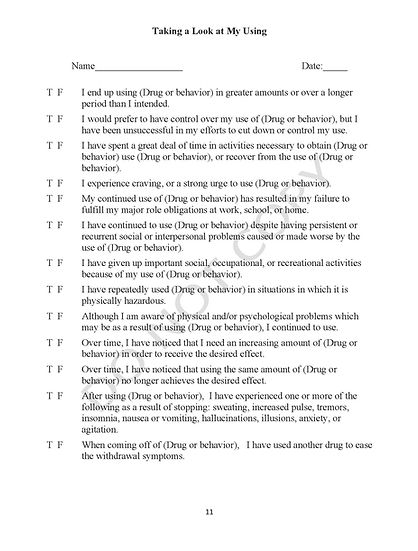

Sample Exercise
Sample Treatment Plan/Charting Notes
$245.00 Include hard copy of exercises and digital copy of Treatment plan and notes for Client Charts.
Benefits:
1) Improved Recovery Rates-Measurable evidence of client progress and recovery.
2) Improved Retention Rates-Proven increase in the ratio of intakes to successful completion and attainment of treatment goals.
3) Improved Client Satisfaction-Measurable increase in client self-reports of the benefits of treatment.
4) Improved Utilization Review-Diagnostic tools, detailed treatment plans, and client notes facilitate the approval and payment for treatment days.
5) Superior Charting in less time-Detailed treatment plans, group and individual notes based upon written client self-reports facilitate the creation of comprehensive and relevant chart notes.
6) Improved Staff Satisfaction-Reduced charting time and clear criteria create greater job satisfaction for mental health professionals.
7) Increased Professional Referrals-Discharge Planners are increasingly likely to refer clients where the receiving facility can clearly demonstrate evidence-based and clinically effective treatment.
MARKETING We can assert to our prospective clients and our referral sources that we can provide evidence-based, planned and comprehensive treatment curriculum. As a result, current and future intakes and referrals benefit.
CLIENT FRIENDLY The exercises contained in the curriculum have been designed over hundreds of clinical hours to become exercises which clients will actually complete. This is because they are brief, simple, and are stimulating to the client.
UTILIZATION REVIEW Our exercises are diagnostic. The questions put forth are taken directly from the DSM-5 and other treatment plans as elements of presenting disorders. This enables the clinician to provide diagnosis and treatment goals which are directly related to client self-reports and declarations. When diagnostic criteria are in client's writing, diagnosis is evidenciary, not professional opinion.
TREATMENT PLANNING The components become specific and essential elements of individualized and comprehensive treatment plans. These treatment plans and exercises directly and comprehensively address the myriad components of substance and co-occurring disorders.
CHARTING Sample clinical notes for both individual and group notes are provided which, when edited, assist the clinician in creating detailed, relevant, and specific charting for individual and group interventions.
AUDITS With clearly planned interventions, complete and detailed charts, both regulatory and billing audits are easier, faster, and with improved compliance approvals, and perceived effectiveness.
RETENTION AND RECOVERY With the benefit of a comprehensive treatment plan, we are more thorough with both diagnosis and treatment. A comprehensive curriculum reduces the likelihood that a client exits or relapses as the result of a treatment oversight.
CLIENT SATISFACTION Client tracking proves that clients recognize the efficacy, preparation, and thorough nature of a planned and detailed clinical treatment.

A group of short stories about the remarkable people in my past who shaped my life.
Whatever your perception of the Divine Plan. I suggest that you will agree and perceive that some people are larger than life in their character and their humanity.
I have liked many of the books I have read. But I believe that, in this case, you will love the people.
$14.99

Who Are You?
Many years working with and learning from people, we are able to see how each found their own sense of purpose and meaning in life. This book first looks at the organic elements of the human species. Next it examines stories of people discovering their own sense of purpose. Finally, it offers guidance on how the individual reader might find their own place of meaning in their universe. Supported by scholarly works and the teachings of the "Masters", this volume is intended to challenge the reader to discover or invent their own path. 134 Pages.


The "Who Ball"
The Who Ball is, perhaps, the most valuable therapy tool you will ever encounter.
Catch the ball and under your thumb will be one of almost 200 questions. Each question is designed to engage the receiver with a fond memory, a challenging thought, a viewpoint, emotion, or attitude.
Catching the ball playfully catches the receiver off guard. The facilitator can then decide if the question is appropriate for the group, and a lively and authentic discussion often ensues.
Use the ball to warm up the group. Or use the ball to recharge a group which has lost energy.
Everyone loves the "Who Ball".
No product

Understanding Addiction:
Understanding Addiction: Propensity, Progression, Crisis, and Recovery
is a brief overview of addiction pathology, as it is understood today.
As a therapeutic tool, it is provided to family members of clients. Only 80 pages, this is a brief primer of addiction pathology for the client and family. 80 pgs.


Recovery Counseling,
The Compassionate Protocols

This volume offers new perspectives and evidence-based adaptions to the treatment of substance disorders. A global shift in the recovery environment and methods increases retention rates, client satisfaction rates, and job satisfaction for mental health professionals. 250pgs.


Recovery 101
Each exercise in the workbook is diagnostic. That is, the client responds to carefully crafted, simple questions which diagnose the attitudes, moods and behaviors which constitute substance and co-occurring disorders. These include attachment disorders, developmental disorders, and Non-Suicidal Self-Injury (NSSI; DSM-5, pp. 803).
The workbook can be purchased individually, or can be published in a manner specific to your treatment center. Each copy will have your graphics and contact information on the front and back covers.
The charting elements of the treatment plans are provided in MS "Word" suitable for editing, charting, and utilization review.
For custom printing options, contact us directly cobrien1947@yahoo.com. 150pgs.
